The Elephant Battle (Yutthahatthi)
According to the historical legends and beliefs handed down, Phra Khun Phaen Wat Ban Krang is closely related to King Naresuan the Great between the years 2135–2137 B.E. (c. 1592–1594 CE), after the conclusion of the Elephant Battle with Phra Maha Uparaja.
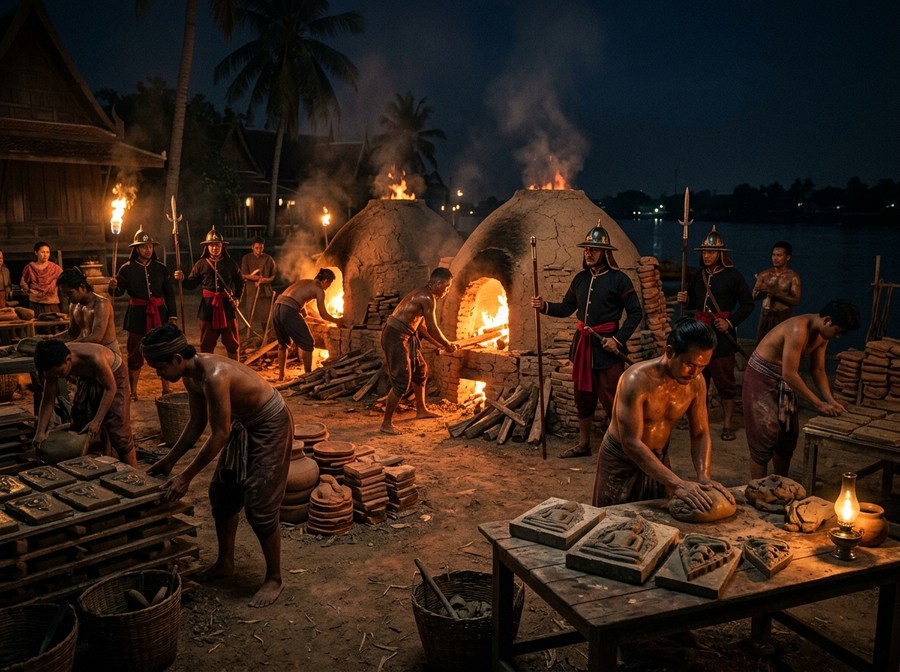
It is assumed that after the King achieved victory over Burma, he marched back and rested his troops near Wat Ban Krang. He then commanded the creation of a massive number of baked clay amulets (following the ancient tradition of 84,000 pieces, equal to the number of Dhamma Khandha or Buddhist doctrines) to be interred in the Wat Ban Krang chedi (stupa).
The Objectives:
- To dedicate merit to the brave soldiers who sacrificed their lives in the war.
- To perpetuate Buddhism, following the custom of warrior kings in the Ayutthaya period.
This is the reason why the Phra Kru Wat Ban Krang amulets are renowned for their protective properties of "Kongkraphan Chatri" (invulnerability) and "Klaew Klaad" (aversion of danger), as they were created in the atmosphere of war and national defense.
Buddhist Characteristics
Modeled After "Phra Phuttha Chinnarat"
A point many scholars observe is the significant resemblance between the characteristics of Phra Khun Phaen Wat Ban Krang and the Phra Phuttha Chinnarat at Wat Phra Si Rattana Mahathat, Phitsanulok Province.
Almost every mold of Phra Khun Phaen Ban Krang (especially the five-sided large and small chest molds) features a "Sum Ruean Kaew" (Crystal Arch) surrounding the Buddha image. The iconographic style is a Buddha image in the Maravijaya (subduing Mara) posture, seated under an exquisite kanok (flame pattern) arch, which is identical to the Phra Phuttha Chinnarat.
King Naresuan may have created this votive tablet because of his strong connection to Phitsanulok (his birthplace) and his highest reverence for the Phra Phuttha Chinnarat, thus having its artistry modeled into the amulets given to his soldiers.
In that era, no one called this votive tablet "Phra Khun Phaen". It was named after its characteristics as "Phra Pim Ha Liam Sum Ruean Kaew" (The Five-Sided Buddha in the Crystal Arch Amulet) or "Phra Pim Plai Koo" (The Twin Plai Amulet).
The core essence was the Buddha within the crystal arch. However, due to the later emerging reputation for Metta Maha Niyom, it was merged with the name of the protagonist in the folk literature of Suphan Buri.
The Pantheon of Pims (ทำเนียบพระกรุวัดบ้านกร่าง)
Explore the vast array of molds discovered within the Wat Ban Krang cache. From the commanding Song Pol to the classic Ha Liam (Five-Sided) models.
Pim Song Pol Yai
The Supreme Commander mold, seated in Samadhi posture. The largest and most majestic of the Ban Krang amulets.
Pim Ok Yai
The "Large Chest" five-sided masterclass. Famous for its long ushnisha penetrating the crystal arch.
Pim Ok Lek
The "Small Chest" variation. Elegant and highly sought after, featuring distinct authenticity markers.
Archaeological Discovery
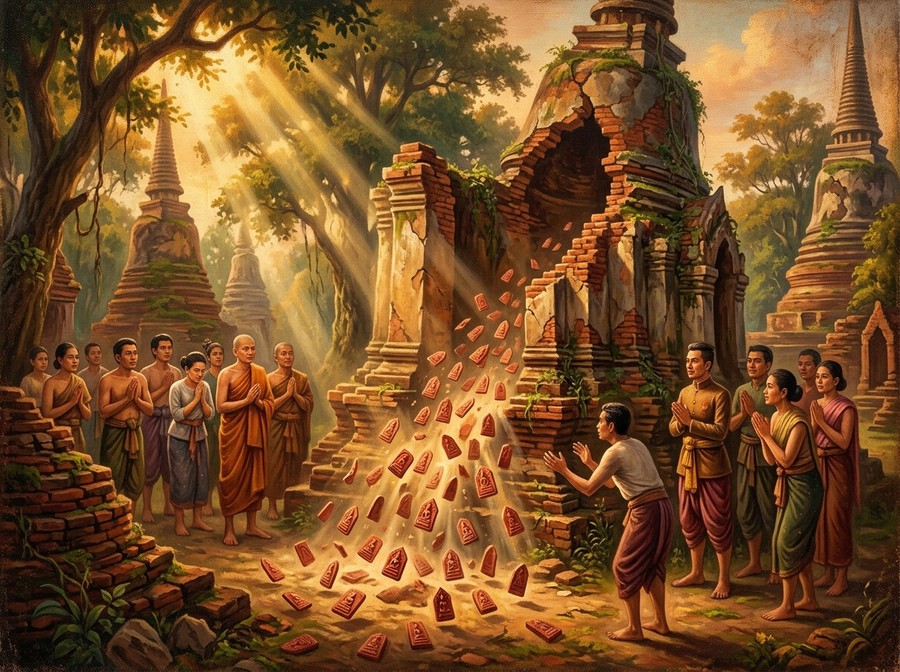
The official discovery of the Wat Ban Krang amulet cache occurred around 2445 B.E. (c. 1902 CE) when the old chedi behind the Wat Ban Krang assembly hall collapsed. Villagers at that time found a large number of amulets scattered around.
Material and Composition: Baked Clay (Nuea Din)
The globally accepted standard for Phra Khun Phaen Wat Ban Krang is "Nuea Din Phao" (baked clay), which has specific characteristics:
- Coarse clay: Contains mixtures of gravel, sand, and various minerals.
- Hardness: Fired at high heat, making the clay highly durable. The colors range from Som Mor Mai (new pot orange), red, brown, to dark green.
- "Waan Lood" marks: The surface of the amulet often has tiny pores caused by the plant-based materials (waan or medicinal herbs) dissolving over time.
The Debate on "Nuea Chin" (Leaden Material)
Regarding the discovery of thin leaden Nuea Chin amulets, the Suphan Buri amulet community discusses the "Kru Baan Pan" or "Kru Pa Khon" caches, which are located not far away. Amulets from these caches sometimes have molds similar to Phra Ban Krang but are made of "Nuea Chin Takua Sanim Daeng" (leaden material with red rust) or Nuea Chin Ngern (silver-leaden material).
However, in academic and collector circles, the paramount and original "Phra Khun Phaen Wat Ban Krang" is accepted to be only Nuea Din (baked clay).
Why the Name "Khun Phaen"?
The intersection of History and Literature. The Epic folk literature Khun Chang Khun Phaen is believed to be based on true events during the Ayutthaya period. When the villagers worshipped the amulets from Wat Ban Krang and experienced high levels of "Metta Maha Niyom", the legend of the hero merged with the artifact.
Evolution of the Amulet
| Topic | Wat Ban Krang (Original) | Later Era (Created by Masters) |
|---|---|---|
| Iconography | Buddha image in the Maravijaya posture within a crystal arch | Thai warrior, riding a horse, holding Kuman Thong, or a Buddha image |
| Main Material | Baked clay mixed with waan (Nuea Din) | Phong Phrai Kuman (child spirit powder), metal, clay, Phong Phutthakhun |
| Meaning | Victory in war and perpetuation of the religion | Metta Maha Saneh (popular loving-kindness and charm), trade, fortune |
| Origin | King Naresuan the Great (approximate) | Famous revered masters (Gaeji Ajarn), such as Luang Pu Tim, Luang Por Kuay |
Author: Ajarn Spencer Littlewood
Homepage: https://www.ajarnspencer.com
Lore Directory: https://khunphaen.com/articles/